
by Daniel K. Elder and Felix Sanchez
May 3, 1998
Download
the True Story of the NCO Creed
It started on the fourth floor of Building 4 at Fort
Benning, Georgia, in 1973 with a plain white sheet of paper
and three letters; N-C-O. From there begins the history of
the Creed of the Noncommissioned Officer
The Creed has been around for many years in different
forms and fashions. Sergeants can recall reading the Creed
on the day they were first inducted into the NCO Corps.
Most of us have a copy hanging on our wall in our office,
our work place, or at our home. Some have special versions
etched into metal on a wooden plaque, or printed in fine
calligraphy. One Sergeant Major of the Army could pick up
and recite the Creed from any place selected.1 But take a
quick glance at any Creed and you will notice the absence
of the author’s name at the bottom. Where the Creed
originated from has questioned many.
To date, there are few historical collections relating
to the noncommissioned officer. In the foreword of one of
the premier studies of the NCO, Guardians of the Republic:
a History of the Noncommissioned Officer Corps of the U.S.
Army, Russell F. Weigley pointed out that “Until the
publication of this book, the American noncommissioned
officers who have provided the backbone of our army have
never been appropriately studied by military historians.”2
In an article on the NCO Creed, Museum of the
Noncommissioned Officer Director Larry Arms noted that,
“History often clouds events, people, ideas, and
occurrences deep within a shroud of obscurity.” And that,
“…until they (events) are considered important, they are
often paid little attention.”3 The Creed is one of those
events. The NCO Journal had published a request for
information about the origins of the Creed in the Spring 96
edition4, yet had received little response.
The earliest mention of the Creed in official and
unofficial publications seemed to be in the year 1989, but
the Creed is older than that. The problem centered on
“which Creed?” As Arms mentions in his article, “In the
early 1980’s I first started seeing NCO Creeds produced by
various commands. Though similar in nature, they differed
in detail.”5 Research had also turned up different versions
of the Creed. A reprint of the Sergeants Book, prepared in
1982 by then 3rd Armored Division Sergeant Major, CSM Robert
Haga, discusses the Creed. In his timeless book, he expressed his “written talk” to the noncommissioned
officers within his Division. On the last page, barely
readable, is a small copy of the familiar “Creed of the
Noncommissioned Officer.”6 Also, on the inside back cover
was the “United States Army Noncommissioned Officer Creed,”
which was an oath that a noncommissioned officer would
repeat or sign. Obviously multiple Creeds were used.
While researching information about NCO
responsibilities in TC 22-6, The Noncommissioned Officer
Guide, there is a reference to the 1989 “NCO Leader
Development Task Force,” which resulted in the publishing
of that Training Circular. It stated that “Drawing heavily
from the Professional Army Ethic (FM 100-1), the NCO CREED
(emphasis added), and the Oath of Enlistment, the Task
Force identified 14 attitudes common to all effective NCO
leaders.”7
The Task Force, directed by LTG John S. Crosby, had as
its mission the job of developing “a strategy and action
plan for improving the Army’s NCO leader development
system….”8 The Task Force was comprised of the Director,
the Commandant of the Sergeants Major Academy (Executive
Agent), two field grade officers, 14 senior noncommissioned
officers, and three civilian specialists. The Task Force
began in January 1989 and ran until early June 1989. Their
18 recommendations included aligning the noncommissioned
officer education system with promotions, combining two
similar courses into one to be called “Battle Staff”, and
“Approve the NCO skills, knowledge, and attitudes (SKA),”9 and resulted in superceding Field Manual 22-600-20, The
Army Noncommissioned Officer Guide, 13 November 1986.
Recommendation 1 of the study identified that the
“Attitudes” were partially drawn from the NCO Creed!
1989 was an important year for the Noncommissioned
Officer Corps. In keeping with the tradition of “themes”,
the Secretary of the Army, the Chief of Staff, and the
Sergeant Major of the Army announced in January that the
1989 theme would be the “Year of the Noncommissioned
Officer.”10 In 1989, not only was the Task Force formed, the
Creed appeared in numerous publications. In their salute to
NCO’s, the Military Police journal printed on the back
cover a copy of the familiar Creed.11 And then later in that
“Year of the NCO”, other publications would ultimately
print copies of the same Creed, including the Ordnance
magazine,12 and the INSCOM Journal.13
The Leader Development Task Force conducted a
“thorough literature search which included 17 previous
studies concerning leadership and professional
development.”14 Of those studies, one of the most important
was the Noncommissioned Officer Professional Development
Study of 1985. This two-volume study (also known as the
Soldiers Study) has been the guiding document for
noncommissioned officer development since its release in 1986. The study group considered recommendations applicable
for the period 1986 to 2000,15 and of its 45
recommendations, 34 were approved, 9 were deferred, and 2
were disapproved (one of which, the change of retention
control points for sergeant (E-5) was later adopted). These
recommendations have shaped our corps and included tying
NCOES to promotion, redesigning the Enlisted Evaluation
Report (eventually becoming the NCO-ER), and improving the
quality of Reserve Component school training. This was
truly an important study for the evolution of the
noncommissioned officer.
Though the objective of the study was to evaluate
professional development, ALL aspects of NCO professional
the development was studied. One of the doctrinal publications
reviewed was the March 1980 version of The Army NCO Guide.
The study asserted that “While the NCO Guide contains no
factual errors…”16 and went on to endorse eight
recommended changes proposed by COL Kenneth W. Simpson,
Chief, Training and Education, Office of the Chief of
Staff, Noncommissioned Officers Professional Development
Study (who later went on to serve as the Commandant of the
Sergeants Major Academy).
In his DA Form 2028, Recommended Changes to
Publications and Blank Forms (endorsed by the Deputy Director of the study, COL Jacques B. Gerard) dated 15 Oct
85, Simpson’s last recommendation included one enclosure, a
single sheet of paper. His eighth recommendation read:
“The Noncommissioned Officer Creed (copy attached)
should be included in the manual (FM 22-600-20).
Recommend the creed appear on either the inside, front
cover, or in the selection titled ‘The NCO Corps.’
Reason: The creed has been around the Army for over
30 years and is well known to the NCO Corps. It is
frequently used at NCO ceremonies such as NCO Academy
graduations, NCO ‘inductions’, and dining-ins.
However, it currently does not appear in any official
publication. The creed espouses principles which are
consistent with the theme of the NCO Guide, and
including it in the FM will give it “official”
status.“17
The version of the Creed that was submitted to the
Commander of the Training and Doctrine Command (then
proponent for The Army NCO Guide) was a version of the
Creed that we know today. For the first time, with the
publishing of FM 22-600-20 on 13 November 1986 as an
official publication, the Creed of the Noncommissioned
Officer was formalized.18
However, where did the Creed that Simpson submitted
come from? Now a Major General, Simpson is certain that one
of the noncommissioned officers serving on the Soldier
Study panel provided him a copy,19 and he does not recollect
seeing it before about 1980.20
The June 1981 edition of RB 22-600-20, The Duties,
Responsibilities and Authority of NCO’s and the Interplay
and Relationship with the Duties, Responsibilities and
Authority of Officers, published by the U.S. Army Sergeants
Major Academy, in which the summary refers to a creed, “An
official ethical code is the Moral and Ethical
Responsibilities of Leaders; Creed of the Noncommissioned
Officer.”21 However, there is no published copy of the
Creed.
The Army’s search for the origins of the Creed was on.
Soldiers appearing before boards were being asked questions
like “who wrote the Creed?”, and people wanted to know its
history. In preparing research for the U.S. Army Information Management Support Center’s (IMCEN) book The Noncommissioned Officer Corps on Training, Cohesion, and
Combat,22 the compiler, Marianna Yamamoto, discovered a
significant passage. SFC Michael T. Woodward wrote in the
Jul-Aug 1975 issue of the Infantry magazine that, “The Creed of the Noncommissioned Officer was developed by the NCOs of the NCO Subcommittee, Command and Leadership
Committee, Leadership Department USAIS (U.S. Army Infantry
School)23.” In the Spring 97 edition,24 the NCO Journal
printed a story on the Creed based on IMCEN’s information.25
Meanwhile, the number of questions increased about the
Creed’s author.
In October 1972, Sergeant Major of the Army Silas L.
Copeland stated that “a code of ethics…cannot be
developed overnight by edict or official pronouncement. It
is developed by years of practice and performance of duty
according to high ethical standards. It must be selfpolicing.
Without such a code, a professional soldier or a
group soon loses its identity and effectiveness.”26 Could
this have been a call for the development of a document to
guide noncommissioned officers? Was this the impetuous to
develop our Creed?
By 1973, the Army (and the noncommissioned officer
corps) was in turmoil. Of all the post-Vietnam developments
in American military policy, the most influential in
shaping the Army was the coming of the Modern Volunteer
Army (VOLAR).27 With the inception of the Noncommissioned
Officer Candidate Course (NCOC), many young sergeants were not the skilled trainers of the past and were only trained
to perform a specific job, squad leaders in Vietnam.28 The
Noncommissioned Officer System (NCOES) was under
development, and the Army was re-writing its Field Manual
22-100, Leadership, to set a road map for leaders to
follow.
Of those working on the challenges at hand, one of the
only NCO pure instructional departments at the U.S. Army
Infantry School (USAIS) at Fort Benning, Georgia, was the
NCO Subcommittee, of the Command and Leadership Committee,
Leadership Department. Besides training soldiers at the
Noncommissioned Officer’s Academy, these NCOs also
developed instructional material and worked as part of the
team developing model leadership programs of instruction.29
Of those serving on this team were MSG John Cato
(Chief), SFCs Earle Brigham and Jimmy Jakes, and SSGs
Raymond Brown and Lester Cochran. Michael Woodward would
soon join them.30 They worked under the direction of the
Chief of the Command, Staff and Leadership Department, COL
Nathan Vail†. During one of their many “brainstorming
sessions”, Brigham recalls writing those three letters on a
plain white sheet of paper…N C O.31 From those three letters they began to build the Creed. The idea behind
developing a creed was to give noncommissioned officers a
“yardstick by which to measure themselves.”32 There was an
oath of enlistment for incoming enlistees and an oath of
commissioning for the officers, yet the noncommissioned
officer had nothing that recognized their induction into
the NCO Corps.
The NCO Subcommittee’s first drafts did not make it
through the Infantry Center’s editors, and they rewrote the
Creed numerous times. When it was ultimately approved, the
Creed was designed on a scroll, and printed on the inside
cover of the Special Texts (ST) issued to students
attending the noncommissioned officer courses at Fort
Benning, beginning in 1974. Though the Creed was submitted
higher for approval and distribution Army-wide, was not
formalized by an official Army publication until 11 years
later. Woodward’s Infantry magazine article on
“Followership” was one of a series of articles discussing
leadership. Soon after the article was published, the NCOs
serving on the sub-committee moved on to their next
assignments.
The “unofficial” Creed did not go away. Many of those
sergeants who graduated from the Infantry School took their
copy of the Creed and shared it with the Army. Other
commands may have copied, revised, or reworded it, yet they
all basically followed the format of the original. When
first written, the Creed began, “No man is more
professional than I….” At the time the Creed was
developed, the Women’s Army Corps (WAC) had not been
integrated into the Army. Much later, at a senior NCO
conference, several female Command Sergeants Major objected
to the masculine wording of the Creed. As a result, the
Army began using the non-gender specific version we know
today.33
Though re-written many different ways, the Creed still
today begins its paragraphs with those three letters,
N C O. It continues to guide and reinforce the values of
the new generation of noncommissioned officers. At the time
of its development, the sergeants of the NCO Subcommittee
were unaware of the impact the Creed would have in the
coming years. However, the goal of providing a tool for
measuring the competencies of a noncommissioned officer was
achieved, and is forever a part of our history.
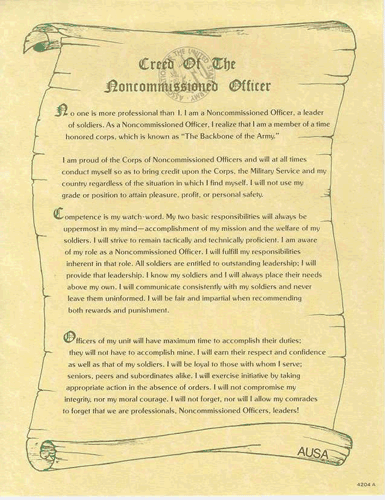
Creed of the Noncommissioned Officer
FM 22-600-20, The NCO Guide, November 1986
No one is
more professional than I. I am a
Noncommissioned Officer, a leader of soldiers. As a
Noncommissioned Officer, I realize that I am a member of a
time honored corps, which is known as “The Backbone of the
Army.”
I am proud of the Corps of Noncommissioned Officers
and will at all times conduct myself so as to bring credit
upon the Corps, the Military Service and my country
regardless of the situation in which I find myself. I will
not use my grade or position to attain pleasure, profit, or
personal safety.
Competence is my
watch-word. My two basic
responsibilities will always be uppermost in my mind–
accomplishment of my mission and the welfare of my
soldiers. I will strive to remain tactically and
technically proficient. I am aware of my role as a
Noncommissioned Officer. I will fulfill my responsibilities
inherent in that role. All soldiers are entitled to
outstanding leadership; I will provide that leadership. I
know my soldiers and I will always place their needs above
my own. I will communicate consistently with my soldiers
and never leave them uninformed. I will be fair and
impartial when recommending both rewards and punishment.
Officers
of my unit will have maximum time to
accomplish their duties; they will not have to accomplish
mine. I will earn their respect and confidence as well as
that of my soldiers. I will be loyal to those with whom I
serve; seniors, peers and subordinates alike. I will
exercise initiative by taking appropriate action in the
absence of orders. I will not compromise my integrity, nor
my moral courage. I will not forget, nor will I allow my
comrades to forget that we are professionals,
Noncommissioned Officers, leaders!
Creed of the Noncommissioned Officer
NCO Subcommittee version, published in 1975 Infantry magazine
No man is
more professional than I. I am a
Noncommissioned Officer, a leader of men. As a
Noncommissioned Officer, I realize that I am a member of a
time honored corps, which is known as “The Backbone of the
Army.”
I am proud of the Corps of Noncommissioned Officers
and will at all times conduct myself so as to bring credit
upon the Corps, the Military Service and my country
regardless of the situation in which I find myself. I will
not use my grade or position to attain pleasure, profit, or
personal safety.
Competence is my
watch-word. My two basic
responsibilities will always be uppermost in my mind–
accomplishment of my mission and the welfare of my men. I
will strive to remain tactically and technically
proficient. I am aware of my role as a Noncommissioned
Officer. I will fulfill my responsibilities inherent in
that role. All soldiers are entitled to outstanding
leadership; I will provide that leadership. I know my
soldiers and I will always place their needs above my own.
I will communicate consistently with my men and never leave
them uninformed. I will be fair and impartial when
recommending both rewards and punishment.
Officers
of my unit will have maximum time to
accomplish their duties; they will not have to accomplish
mine. I will earn their respect and confidence as well as
that of my soldiers. I will be loyal to those with whom I
serve; seniors, peers and subordinates alike. I will
exercise initiative by taking appropriate action in the
absence of orders. I will not compromise my integrity, nor
my moral courage. I will not forget, nor will I allow my
comrades to forget that we are professionals,
Noncommissioned Officers, leaders of men.
Works Cited
1 Abrams, SSG David “SMA McKinney launches each day with NCO Creed,” NCO
Journal (Fall 1995)
Fort Bliss, TX, pp. 14-15″
2 Fisher, Ernest F. Jr, Guardians of the Republic, the History of the
Noncommissioned Officer Corps of the
U.S. Army. Ballantine Books, NY 1994 p. ix
3 Arms, L.R. “The NCO Creed.” The Chevron, Winter 1998, p. 4
4 NCO Journal, editor Spring 96 issue, Fort Bliss, TX, inside back cover.
5 Arms, L.R. “The NCO Creed.” The Chevron, Winter 1998, p. 4
6 Haga, CSM Robert L. Sergeants Book, Headquarters, 3D Armored Division
Memorandum, APO, NY
09039, 15 NOV 1982, p. 10
7 TC 22-6, The Army Noncommissioned Officer Guide, signed by GEN Carl E.
Vuono, Chief of Staff,
Department of the Army publication, 1990 p. 46
8 Action Plan, Noncommissioned Officer Leader Development Task Force,
prepared by Noncommissioned
Officer Leader Development Task Force, Headquarters, US Army Sergeants
Major Academy, Fort Bliss,
TX, June 1989 p. v
9 – – Task Force, p. A-3
10 Memorandum The 1989 Army Theme: The NCO, by HON John O. Marsh..[et al.],
Headquarters,
Department of the Army, Washington DC
11 Military Police, Fort McClellan, IL, Jan 89, back cover
12 Ordnance The Professional Bulletin of the Ordnance Soldier, Aberdeen
Proving Ground, MD, Nov 89,
p. 21
13 The INSCOM Journal, designed by Ron Crabtree, Fort Belvoir, VA, Aug/Sep
89, back cover
14 Action Plan, Noncommissioned Officer Leader Development Task Force, p.
ix
15 Noncommissioned Officer Professional Development Study (Final Report
Volume I) , prepared by the
NCO Professional Development Study Group, Washington D.C., Feb 86, p. 1
16Noncommissioned Officer Professional Development Study (Final Report
Volume II) , prepared by the
NCO Professional Development Study Group, Washington D.C., Feb 86, p. F-2
17- -p. F-4 thru F-6
18 FM 22-600-20, The NCO Guide, TRADOC, 13 November 1986, inside cover
19 Simpson, MG Kenneth W., Letter to Elder, undated
20 Ibid.
21 RB 22-600-20, The Duties, Responsibilities and Authority of NCO’s and
the Interplay and Relationship
with the Duties, Responsibilities and Authority of Officers, by the U.S.
Army Sergeants Major Academy, Ft
Bliss, TX June 1981, p. 7-2
22 The Noncommissioned Officer Corps on Training, Cohesion, and Combat
Information Management
Support Center, Washington, DC, 16 December 1997, p. 31
23 Woodward, SFC Michael T. “The Subordinate: The Art of Followership”
Infantry, Fort Benning, GA
Jul-Aug 75, p. 25-27.
24 Abrams, SSG David, “Origin of the NCO Creed…Still Searching” NCO
Journal, Spring 97 Fort Bliss,
TX p. 21
25 Yamamoto, M. Merrick, phone conversation with Elder, Jan 98.
26 Copeland, SMA Silas L. “The NCO Must Grow with the Army” Army,
Washington, DC, Oct 72,
pp24-25
27 Fisch, Arnold G. and Wright, Robert K., The Story of the Noncommissioned
Officer Corps, Center of
Military History, Washington D.C., June 1989, p. 130
28 Bainbridge, SMA William G. Top Sergeant Ballentine Books, New York, 1995
p. 203
29 “TRADOC Leadership Conference Report”, Fort Benning, GA 28 July-1 August
1975, p. 1
30 Woodward, Michael T. Phone conversation with Elder, 7 March 1998
31 Brigham, Earle G. Phone conversation with Elder, 7 March 1998
32 Ibid.
33 – – Abrams, “Origin of the NCO Creed…Still Searching”, p. 21